About the collection
The 1991 Project records long-form oral histories with reformers and close witnesses to India’s economic transformation. These conversations cover the decades before the crisis of 1991 and trace the narrators’ education, careers, mentors, institutions, and the development of the ideas that later became policy. They preserve details that are often missing from official records: how policy ideas developed, how institutions worked, how decisions were made, and how the people involved understood the choices before them.
Where the reformers and their ideas came from is as much a part of the story as the summer of 1991 itself.
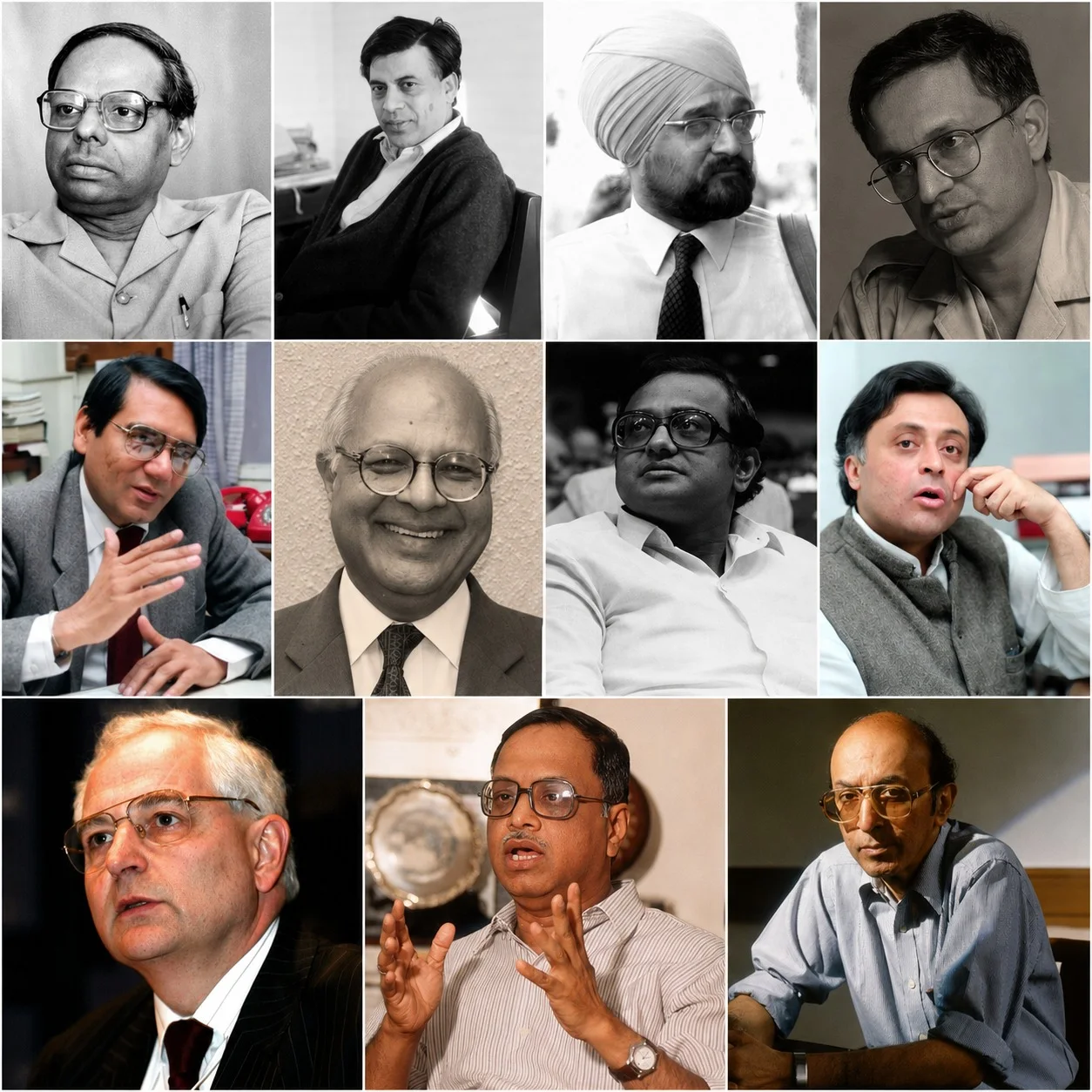
Between 2021 and 2026, the project recorded interviews with:
- C. Rangarajan
- Vijay Kelkar
- Montek Singh Ahluwalia
- P. Chidambaram
- Ashok Desai
- Shankar Acharya
- Rakesh Mohan
- N. R. Narayana Murthy
- Martin Wolf
- Jairam Ramesh
- Tarun Das
Many of these oral histories span several sessions, and each session was recorded and transcribed.
The collection also includes a 2016 interview with Dr. Manmohan Singh recorded by journalist Chaitanya Kalbag around the 25th anniversary of the 1991 reforms. Kalbag’s contribution preserves one of the last interviews in which Dr. Singh reflected on the reforms he launched as finance minister.
The committee reports, policy documents, books, papers, and other materials discussed in the interviews can be found in the 1991 Project’s public repository.
Audio credits: Varun Venkataraman, Anand Krishnamoorthi, Anshul Jain, Prakhar Yadav, Saurabh Mishra, Krishna Bhat, Archana Marathe, Dallas Floer, and Rowan Dennis
Senior Producer: Gaurav Chintamani
Legal: Rakshanda Deka and Pradyuman Kaistha
Transcripts: Mary Horan and Aakrith Harikumar
Video:
Produced by Nomsita Haritashya, Swapnalok Studios
Conceptualized by Shreyas Narla
What is available?
Recordings and transcripts are available for those we have permission to provide access. Some interviews are subject to an embargo, while others are still awaiting permission. If the materials you request are not yet available, we will notify you when they are released. More oral histories will be added as we conduct further interviews.
Requesting materials
To request a recording or transcript, write to:
[email protected]
Please include your name, the name of the narrator, and one sentence about your work. No formal proposal or institutional affiliation is required.
We will send the materials currently authorized for access, together with the recommended citation and terms of use.
Using the oral histories
Oral histories are first-person recollections. They preserve memory, interpretation, and individual points of view. They may differ from documentary records or from the recollections of other witnesses. Please read and listen to them alongside the policy documents, committee reports, contemporary writings, and other relevant sources, including those in the 1991 Project’s public repository.
The views expressed in each oral history are those of the narrator and do not necessarily reflect the views of the 1991 Project, the Mercatus Center, George Mason University, or their affiliates.
Please quote the interviews accurately, fairly, and in context. Do not imply that a narrator, the 1991 Project, the Mercatus Center, or George Mason University endorses your work.
License and terms of use
The recordings and transcripts made available through this collection are licensed under the Creative Commons Attribution–NonCommercial–ShareAlike 3.0 Unported License (CC BY-NC-SA 3.0).
Under this license, you may copy, share, quote from, and adapt the material, provided that you:
- use the material only for non-commercial purposes;
- give appropriate credit to the narrator and the Mercatus Center;
- cite the relevant oral-history session;
- clearly indicate if you have edited, translated, excerpted, or otherwise changed the material;
- distribute any adapted material under the same CC BY-NC-SA 3.0 License; and
- do not impose legal or technical restrictions that prevent others from exercising the rights granted by the license.
Commercial use of the recordings, transcripts, or adaptations is not permitted.
How to cite an oral history
Every released transcript includes its recommended citation. When quoting from an oral history, cite the narrator, the session number, the interview date, and the relevant transcript page number. When citing the audio, include the relevant timestamp.
A standard citation may follow this format:
[Narrator], oral history interview by [interviewer or interviewers], Session [number], [date], The 1991 Project Oral History Collection, Mercatus Center at George Mason University, p. [page number].
Accessibility
We provide a searchable transcript for each audio recording. If essential visual information is not conveyed through the audio, we include that information in a descriptive transcript.
Help us build the archive
The 1991 Project is a growing public-history archive. If you have papers, reports, photographs, correspondence, or memories of the reform years that are not yet represented in the collection, please write to us. We also welcome corrections, additional context, and new materials that can strengthen the historical record.
Please write to [email protected].